 Machine Octopus
Quality used machinery from trusted brokers
Used metal processing machines: a lowdown on the big-hitter brands, and why buying German is still the way to go
A buyer's guide to CNC machine tools and laser cutting on the used market
DMG Mori and Trumpf both dominate metal processing listings, but they're not competing with each other - one removes metal, the other cuts and shapes sheet. Here's the difference, and what to check in each.
Metal processing is our second-largest category, 1,255 machines, but it covers far more ground than the name suggests. Scroll through it and you'll find eccentric presses, gear grinders, band saws, and forging hammers alongside CNC lathes and laser cutters. Two names anchor the two biggest parts of that range, and they're not competing with each other, they're doing entirely different jobs. DMG Mori (which also trades under its legacy names Deckel Maho and Gildemeister) covers machine tools that remove metal - turning and milling. Trumpf covers machine tools that cut and shape sheet metal - laser cutting and punching. Knowing which job you actually need doing matters more here than anywhere else on the site, because these two brands don't overlap at all.
Why these two, and not something cheaper and newer
Germany's machine tool reputation isn't just brand mythology. German manufacturers typically work to exceptionally tight tolerances, often specifying critical components to within a single micron, and around 64% of German CNC machinery output gets exported, which is a fair proxy for how much the rest of the world trusts the standard. That reputation is exactly why a DMG Mori lathe or a Trumpf laser still holds real value ten or twenty years after it left the factory.
Chinese-built machine tools have improved considerably in recent years and are a legitimate option new, particularly on price, often 30-50% cheaper than German or Japanese equivalents. But that's a different question to the one this guide is answering. We're a used marketplace, and the reason DMG Mori and Trumpf dominate used listings while newer, cheaper brands barely feature is resale value: a well-known brand with a multi-decade duty-cycle track record still fetches a real price a decade on, while a newer budget machine, however capable when new, simply hasn't been around long enough to prove itself on the secondhand market yet. If you need ultra-tight tolerances or can't afford downtime, that track record is worth paying for. If your requirements are more forgiving, a new budget machine is a legitimate alternative, just not typically one you'll find on a site built around used equipment.
DMG Mori, Deckel Maho, and Gildemeister: one company, two specialisms
This is a merger history worth knowing before you buy, because it explains why the same machine group shows up under three different names in our listings. Gildemeister was founded in Bielefeld in 1870. Deckel (Munich, 1903) and Maho merged in 1993 to form Deckel Maho, which combined with Gildemeister soon after. In 2009, the German group merged with Japan's Mori Seiki to form DMG Mori, and Mori Seiki took a controlling 52.5% stake in 2015. On the used market, the older brand names still stick to what each did best: Gildemeister-badged machines tend to be turning-focused, and Deckel Maho-badged machines tend to be milling and machining-centre focused. A Gildemeister CTXA-400 S2, currently listed, is a 2001 CNC lathe with 635mm of Z-axis travel and a 5,000rpm top speed - a lathe like this is what turns shafts, bushings, sleeves, and threaded fittings, the kind of work that keeps automotive subcontractors and oil and gas suppliers (valve bodies, pipe flanges) in business. A Deckel Maho DMU 70 eV, currently on our site, is a 2003 5-axis universal machining centre built for milling rather than turning, better suited to mould and die tooling, aerospace structural components, or medical implants, anything with geometry too complex for a lathe to reach. Same corporate family, two different jobs.
Trumpf: the name behind sheet metal fabrication
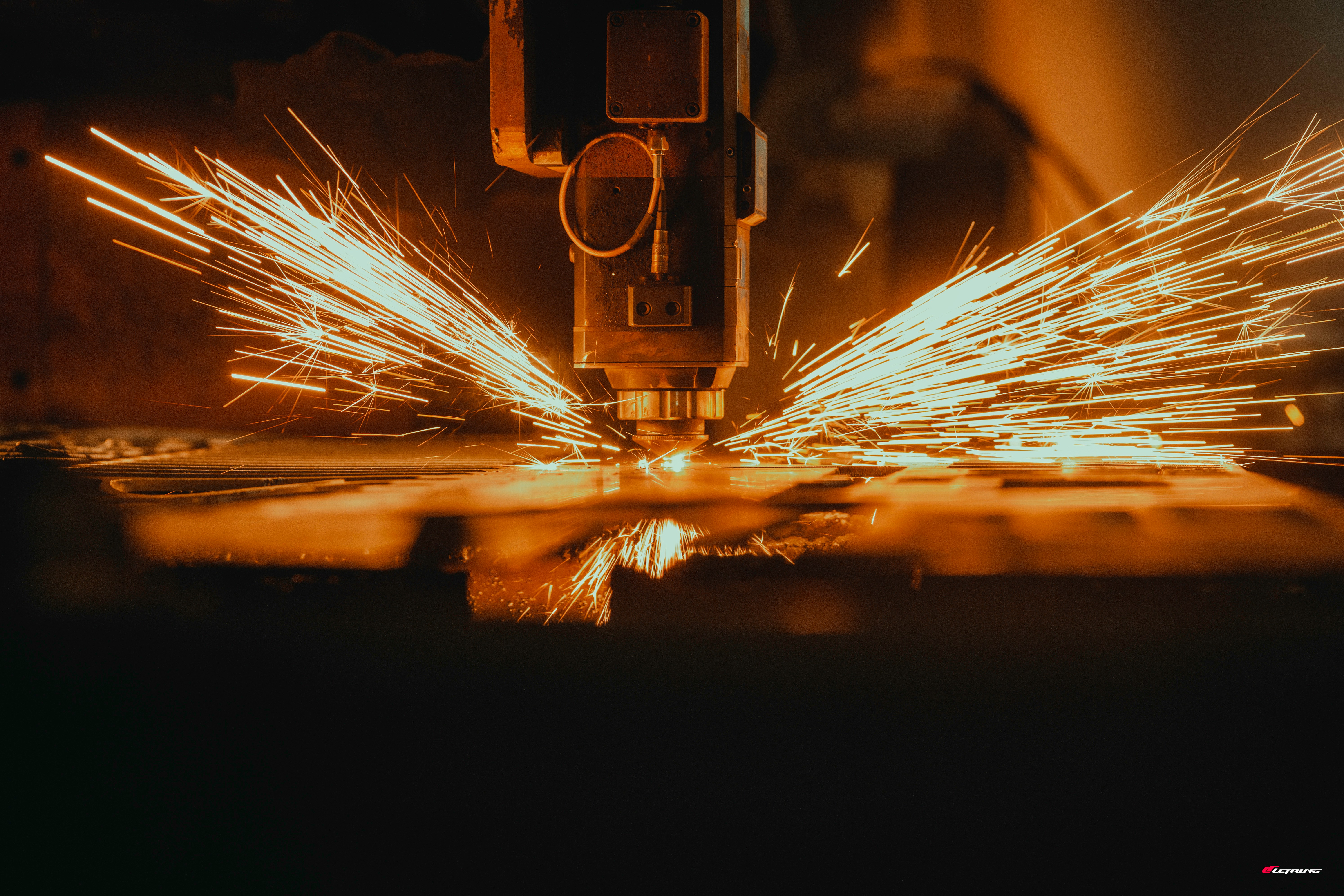
Trumpf is a different business altogether, and still family-owned. Founded in Stuttgart in 1923 and now based in Ditzingen, it's controlled by the Leibinger family and turns over more than €4 billion a year. Its territory is flat sheet, not solid stock: laser cutting under the TruLaser name, punching under TruPunch, and combined punch-laser systems under TruMatic. A Trumpf TruLaser 5040, currently listed, is a 2016 CNC laser cutting system with a 4,000mm x 2,000mm working range and 5,000W of laser power, built for cutting mild steel, stainless steel, and aluminium sheet - this is the machine behind fabricated enclosures, structural brackets, and the heavier plate work that goes into shipbuilding and pressure vessels. A Trumpf Trupunch 3000, also currently listed, punches rather than cuts - 180kN of punching force across a 2,500mm x 1,250mm working area, well suited to electrical enclosures, server racks, and HVAC parts, anywhere holes and formed features matter more than a cut edge.
What actually matters more than the badge
For machine tools in the DMG Mori family, the numbers that decide fit are axis travel, spindle speed, spindle taper, and which control is fitted - Heidenhain, Siemens, and Fanuc all show up across our listings, and parts availability varies by generation. For laser and punch machines from Trumpf, it's laser power in kilowatts, working area, maximum material thickness, and punching force. These aren't comparable specs across the two brands, because they're not comparable machines - a 5kW laser and a 400mm turning diameter aren't answering the same question, so there's no "better brand" here the way there is between, say, Arburg and Krauss Maffei. Work out which job you're actually buying for first, then compare specs within that job.
A few things specifically catch people out on this category. On the DMG Mori side, it's worth asking whether the control is original to the machine or has been retrofitted - a swapped-out control can mean the manufacturer won't officially support it, and tracking down documentation or software after a change of ownership is sometimes impossible. However good a machine looks running in a seller's workshop, moving a precision machine tool also means relevelling and recalibrating it on your own floor before you can trust its accuracy again - budget a technician for that, not just a haulage invoice.
On the Trumpf side: laser source hours are tracked separately from overall machine hours, and they matter more for running costs. Older CO2 laser sources (the TruFlow range) need gas consumables and periodic mirror alignment; newer fibre and disk sources (TruDisk, and the "fibre" models in the TruLaser range) are solid-state, with no gas supply and generally lower maintenance. Ask for both hours figures, not just the headline number on the machine. And whichever laser source it has, cutting still needs an actual gas supply, typically around 30 bar nitrogen and 20 bar oxygen, which isn't included with the machine. Bottled gas delivery or an on-site nitrogen generator is a real running cost, easy to miss when you're only looking at the purchase price.
Where to look
We list DMG Mori, Deckel Maho, Gildemeister, and Trumpf machines, along with many other manufacturers, in our metal processing machines category. And before you commit to anything, our due diligence checklist covers what to ask for and check first.
This article is for general informational purposes only and does not constitute legal, financial, tax, or professional advice. Always confirm compliance, tax, and import requirements with a qualified professional or the relevant authority before making a purchasing decision.
More Articles
View all articles →
17 September 2026
The oldest machines on Machine Octopus, and what they were built to make
Fifteen machines built between 1940 and 1959 are still listed and still working. Here is what each one actually does.
17 September 2026
Pre-1960 machine tools: the full inspection guide
How to read way wear, test a spindle, spot the parts that actually fail, and where you stand legally on a machine built before CE marking existed.
31 August 2026
How to sell used industrial machinery in 2026: pricing it right, and what actually makes a buyer commit
What actually determines how fast a used machine sells, and why holding out for scrap rarely pays off